

Choosing Between Liquid and Air Cooling for Your Facility
As AI and cloud technologies advance, the demand for effective cooling solutions grows, making liquid cooling a more viable option for handling high-density data centers. These environments often exceed the capabilities of traditional air cooling systems as rack densities reach up to 1000kW, risking equipment overheating and costly downtime without proper cooling.
Understanding Liquid vs. Air Cooling
Liquid cooling offers a more direct approach by using water or specialized nonconductive fluids to absorb and dissipate heat from servers, which is particularly effective in high-density settings. This contrasts with air cooling, where air circulates to remove excess heat, suitable for less dense environments. Options like the Liebert PDX Compact DX Cooling System highlight how different solutions cater to various densities.
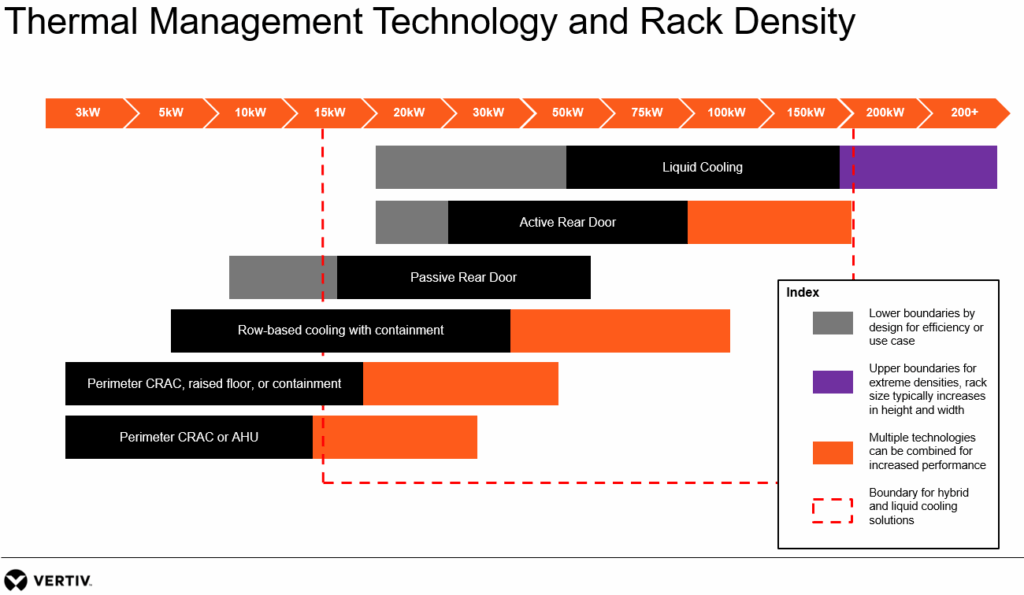
Air cooling involves using air as a medium to displace heat, but it may not suffice for high-density arrangements. In contrast, liquid cooling options such as direct-to-chip cooling, rear door heat exchangers, or immersion cooling offer robust alternatives to efficiently manage the generated heat in advanced data centers.
Incorporating both air and liquid cooling can be advantageous. The hybrid method, exemplified by the Vertiv™ CoolChip CDU, utilizes liquid cooling for precise chip heat management while air conditioning handles broader climate control, optimizing energy usage and performance.
Determining the Best Cooling Strategy for Your Data Center
Choosing the right cooling solution depends on your facility’s specific requirements. For racks consuming less than 20kW, air cooling methods like the Liebert DS Direct Expansion Cooling System can effectively replace hot air with cool air. However, for racks using more than 20kW, liquid cooling becomes crucial, particularly when power usage exceeds 30kW, as it can handle the excessive heat output more efficiently than air alone.
Facing rapid technological growth, hybrid cooling approaches become imperative for maintaining optimal conditions while minimizing costs. As new cooling technologies emerge, facilities must adapt by integrating these systems for enhanced performance and energy savings.
Explore Advanced Cooling Solutions for Your Facility
Maintaining the ideal environment for your critical equipment extends beyond temperature control to include secure and organized setups. With the rapid progression of technology, staying informed about new cooling solutions can be challenging. Contact us at 748.123.1234 to discover how our solutions can optimize your facility’s cooling infrastructure. Subscribe to our newsletter for insights on the latest advancements.
Frequently Asked Questions About Liquid Cooling
1. What is the main advantage of liquid cooling over air cooling?
Liquid cooling is more effective in managing the heat from high-density environments by using fluids to absorb and dissipate heat directly from equipment.
2. At what rack density should I consider liquid cooling?
Consider liquid cooling for racks exceeding 20kW, with a strong recommendation for those over 30kW to handle the increased heat output.
3. Can liquid cooling and air cooling be used together?
Yes, a hybrid approach often combines the strengths of both methods to maintain optimal temperature control while reducing energy consumption.
4. How does liquid cooling impact energy consumption?
Liquid cooling can be more energy-efficient, particularly when using pumps instead of compressors, resulting in reduced power usage.
5. What are some liquid cooling methods?
Direct-to-chip cooling, rear door heat exchangers, and immersion cooling are popular methods that efficiently manage heat in high-density data centers.