
UPS Systems &
Backup Power Solutions
Uninterruptible power supply (UPS) systems protect critical equipment from outages, voltage sags and surges, and other power quality problems that put uptime, data, and hardware at risk. From compact rackmount units to large modular systems built for data centers and high-density IT loads, the right UPS depends on your facility’s critical load, runtime needs, and growth plans.
Common Framework helps organizations select, size, install, and maintain UPS equipment that fits their environment. Explore the guidance below or reach out to talk through your specific needs.
UPS Systems Keep Critical Equipment Running When the Power Fails
A power outage doesn’t wait for a convenient time. Neither does a voltage sag, a utility brownout, or a surge that rides in on the grid during a storm. For a data center, server room, hospital, or manufacturing floor, even a few seconds without clean, stable power can mean:
- Lost data
- Damaged equipment
- Failed transactions
- Full operational shutdown
An uninterruptible power supply system is the first line of defense against these disruptions. We help organizations select, size, install, and maintain UPS equipment that fits their facility, critical load, and growth plans.
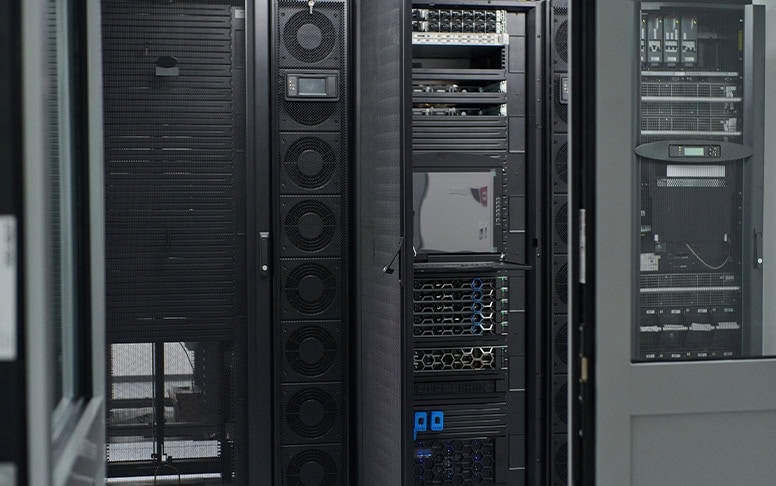
Why Power Protection Matters
Most facility managers and IT directors already understand that downtime is expensive. What’s less obvious is how many different problems a UPS system is quietly guarding against every day:
- Outright power outages — utility failures, storm damage, grid instability
- Voltage sags and surges — short dips or spikes that stress power supplies and shorten equipment life
- Dirty power — harmonic distortion and noise that degrade sensitive electronics over time
- Generator transition gaps — the seconds between utility failure and generator startup, when equipment has no protection unless a UPS bridges the gap
- Aging infrastructure — UPS systems and batteries that quietly lose capacity until the moment they’re needed most
None of these problems announce themselves in advance. That’s exactly why UPS systems and the broader critical power environment around them (generators, power distribution and PDUs, batteries, and monitoring) need to be planned as a system, not purchased as an afterthought.

How a UPS System Protects Facilities
A UPS sits between utility power and connected equipment, monitoring power quality. Standby and line-interactive units switch to battery when a problem occurs; online double-conversion units run the load on the inverter, with no transfer. This prevents connected equipment from being disrupted.
That backup power isn’t meant to run a facility indefinitely. Its job is typically one of two things:
- Bridge the gap until a backup generator starts and stabilizes, or
- Provide enough runtime for a safe, orderly shutdown if no generator is present or if the outage extends beyond generator support.
The exact runtime a UPS can provide depends on the connected load, the battery configuration, and the system design. There’s no universal number, which is exactly why sizing and planning matter more than the UPS unit itself. A UPS is one component in a larger critical power chain that includes utility power, generators, transfer switches, PDUs, batteries, and the racks and IT loads it ultimately protects.
Is your facility ready for a UPS upgrade?
Our Process
1
Evaluate
Browse our products to discover scalable, efficient solutions to meet your needs.
2
Design
Partner with us to design your ideal environment with flexible configurations to meet your specifications.
3
Deploy
Drive transformation and operate reliably and efficiently with systems that are easy to assemble and maintain.
4
Empower
Empower your people, processes, and systems with high performing equipment backed by trusted brands.
Where UPS Systems Are Used
UPS systems show up anywhere continuous, clean power is non-negotiable:
Data Centers and Colocation Facilities
Server Rooms and Network Closets
Healthcare Facilities
Higher Education Campuses and Research Facilities
Government Buildings and Public Infrastructure
Manufacturing and Industrial Facilities
Logistics and Distribution Operations
Financial Institutions and Transaction-Dependent Businesses
Telecom Infrastructure and Edge Computing Sites
General Enterprise IT Environments
Each of these environments has different tolerance for downtime, different load profiles, and different regulatory or operational pressures. That’s why you need an expert in UPS systems to help you find the right solution for your unique needs.
Types of UPS Systems
UPS technology generally falls into three categories. Understanding the differences helps clarify how much protection a given environment actually needs. More protection isn’t always necessary, but under-protecting a critical load is an unacceptable risk.
Standby UPS
Line-Interactive UPS
Online Double-Conversion UPS
Common Framework can walk through which category fits a specific facility, load, and risk tolerance rather than defaulting to the most expensive option or the cheapest one.
Form Factors: Matching the UPS to the Facility
UPS systems come in a range of physical configurations, and the right one depends on available space, the size of the critical load, runtime requirements, serviceability, and how much room there is to grow:
- Desktop and small tower units for individual workstations, point-of-sale systems, or single pieces of network equipment
- Rackmount UPS systems built to integrate directly into a server rack alongside networking and compute equipment
- Modular, scalable UPS systems that allow additional power modules to be added as load grows, without replacing the entire system
- Larger three-phase, facility-level UPS systems designed to protect an entire data center, server room, or critical facility load
Facilities running higher-density IT environments — including those supporting AI or high-performance computing workloads — are increasingly outgrowing older single-unit UPS designs in favor of modular architectures that can scale capacity and redundancy over time without a forklift upgrade.


Sizing and Load Planning for UPS Systems: Getting the Numbers Right
A common mistake in UPS selection isn’t choosing the wrong type. It’s sizing by guesswork, whether that means assuming “bigger is safer” or planning only for today’s load.” Proper UPS sizing depends on several factors working together:
- Connected load — the actual power draw of everything the UPS needs to protect
- Voltage and power factor — how the load behaves electrically, not just its wattage
- comRedundancy — whether the facility needs N+1 or higher redundancy so a single UPS failure doesn’t take down the load
- Growth plans — sizing for today’s load while leaving headroom for tomorrow’s
Oversizing wastes capital and floor space, and can leave the UPS running at low, less efficient loads. Under sizing creates a false sense of security that fails at the worst possible moment. This is where a consultative sizing conversation, not a spec-sheet guess, matters most, and it’s a core part of how Common Framework works with clients.
UPS Runtime: How Long Is Long Enough?
Runtime is one of the most misunderstood aspects of UPS planning. A UPS doesn’t need to run a facility for hours in most cases. It must run it for exactly as long as the situation requires, which depends entirely on what’s on the other side of the outage:
- If a generator is present and reliable, the UPS may only need enough runtime to bridge the gap until the generator stabilizes.
- If no generator is present, or if outages regularly extend beyond generator support, extended battery runtime becomes far more important.
Runtime also decreases as load increases, often faster than proportionally, so adding equipment can shorten runtime more than you’d expect.
Getting this calculation right is part engineering, part operational judgment about how the facility actually experiences outages.

UPS Batteries: The Component Most Often Ignored Until It Fails
Batteries are the part of a UPS system most likely to fail quietly. A UPS can look perfectly healthy on the outside while its battery has lost significant capacity, until the moment it’s called on and doesn’t deliver.
Both valve-regulated lead-acid (VRLA) and lithium-ion batteries are common in UPS systems today, each with different tradeoffs in lifespan, footprint, and total cost of ownership. Rather than assuming one is universally better, the right choice depends on the facility’s runtime needs, budget, and maintenance program.
What matters most regardless of battery type is a real maintenance discipline: scheduled testing, monitored replacement cycles, and battery monitoring that flags degrading capacity before it becomes a failure. A UPS is only as reliable as the batteries inside it.
UPS Monitoring: Visibility Before a Problem Becomes an Outage
A UPS system that isn’t being monitored is a UPS system that’s one silent failure away from an unplanned outage. Modern UPS monitoring can include:
- Remote visibility into UPS status and load levels
- Battery health alerts and predictive replacement flags
- Network management cards for integration with existing IT monitoring tools
- Environmental monitoring for temperature and humidity around critical equipment
- Event logs that make it possible to spot patterns before they become failures
Monitoring turns a UPS from a passive box into an active part of a facility’s uptime strategy, and it’s often a straightforward upgrade for facilities running older UPS equipment.


Maintenance for UPS Units
UPS systems are not “install and forget” tools. They require ongoing attention and maintenance to ensure they perform when they’re needed. A responsible maintenance plan typically includes:
- Regular physical and electrical inspections
- Battery testing and load bank testing
- Firmware and management software checks where applicable
- Load reviews as facility equipment changes over time
- Lifecycle planning for when components, or the whole system, are approaching end of reliable service life
Facilities that treat UPS maintenance as a checklist item rather than an ongoing program are the ones most likely to discover a problem during an actual outage, the worst possible time.
How UPS Systems Fit With Generators and PDUs
A UPS is one link in a larger power protection chain. During a utility failure, the UPS carries the load immediately, with no delay. Within seconds, a backup generator starts and stabilizes, and a transfer switch shifts the load to generator power. The UPS only needs to bridge that gap, and once utility or generator power is stable, it returns to standby and recharges its batteries.
From there, PDUs deliver that protected power to individual racks and pieces of equipment. Metered and switched PDUs add per-circuit or per-outlet visibility and control, and feeding dual-corded equipment from redundant A/B power paths helps ensure that a single PDU or circuit failure doesn’t take down the load. Thinking about UPS, generator, and PDU planning together, rather than as separate purchases, is one of the clearest ways to close gaps in a facility’s power protection strategy.
From there, PDUs (power distribution units) manage how that protected power actually reaches individual racks and pieces of equipment, giving facilities granular control and visibility over distribution rather than a single point of failure. Thinking about UPS, generator, and PDU planning together, rather than as separate purchases, is one of the clearest ways to close gaps in a facility’s power protection strategy.
UPS Scalability: Planning for Where the Facility Is Headed, Not Just Where It Is Today
Power demands rarely stay flat. Growing facilities, higher-density racks, and AI or high-performance computing workloads are pushing many organizations past the capacity of UPS systems that were adequate just a few years ago.
Modular UPS architectures make this kind of growth more manageable. Additional power modules, battery cabinets, or rack power distribution capacity can often be added without replacing the entire system. Planning for this kind of scalability up front, even if the facility doesn’t need the additional capacity yet, tends to be far less disruptive than retrofitting under pressure later.


Signs a UPS System Needs to Be Replaced or Upgraded
UPS systems more often degrade gradually, through declining battery capacity, aging components, or a load that has outgrown the original design, then fail all at once. Signs it may be time for an assessment include:
- The UPS is old enough that replacement parts or service support are becoming harder to find
- Batteries are being replaced more frequently, or runtime has visibly declined
- The facility’s connected load has grown since the UPS was originally sized
- There’s limited or no visibility into the UPS’s current health
- Redundancy is inadequate for how critical the connected equipment has become
None of these signs mean a UPS has already failed — they mean it’s worth having someone assess the system before it does.
Why Work With Common Framework for Your UPS Needs
Choosing the right UPS system means understanding a facility’s actual critical load, realistic runtime needs, redundancy requirements, available space, maintenance capacity, and where the facility is headed. Common Framework works with data center managers, facility managers, IT directors, procurement teams, and engineers to bring that full picture together. That includes helping organizations with:
Selection
Sourcing
Battery & Runtime Planning
Monitoring
Maintenance
Replacement & Upgrade Assessment
Scalability Planning
Our goal is never to sell the biggest or most expensive UPS available. We focus on helping facilities protect uptime, protect equipment, and reduce downtime risk with infrastructure that actually fits their needs.
Talk to Common Framework About Your UPS and Backup Power Strategy
Whether you’re sizing a UPS for a new server room, assessing an aging system before it fails, or planning power infrastructure for a growing, higher-density facility, Common Framework can help you think through the full picture — not just the unit on the shelf.
Contact Common Framework today to talk through UPS selection, backup power planning, and critical infrastructure support for your facility.